Book Online Now
03 9583 3093

Nerve Entrapments

Nerve entrapments present as specific symptoms and can include any or several of the following burning, stabbing, shooting and or electric shock type sensations.

Treating Nerve Entrapments: Conservative and Regenerative Treatments

Nerve entrapments present as specific symptoms and can include any or several of the following burning, stabbing, shooting and or electric shock type sensations. The symptoms don’t tend to be aggravated by specific activities, but pressure over the affected nerve can aggravate the sensations and pain.

Causes are commonly due to physical trauma to the nerve from accidents, mechanical factors, tight footwear, ankle sprains, and surgery. Here, the nerve may scar to adjacent fascia layers, catch around anatomical structures, leading to nerve strangulation and swelling. The local blood supply to the nerve gets affected, and causes malfunction, leading to the painful symptoms.

On the foot and ankle, common locations are around the ankle, at the heel and arch, and on top of the foot. Affected nerves we often treat include the sural nerve(outside of the ankle), tibial nerve and its branches- a common one is baxter’s nerve, and the  dorsal fibular cutaneous nerve(from the front of the ankle to top of the foot).

Here at Cheltenham Podiatry, our foot and ankle experts have over 10 years of training in treating such nerve conditions. They aim to treat and resolve the root cause of your pain, by freeing the nerve, repairing damage, and normalizing its function. Treatment ranges from photobiomodulation (laser therapy) to injection therapy, often via precision ultrasound guidance. Injectants range from 5% glucose, vitamin B12, and platelet rich plasma.

The infection provides several functions:

  1. To physically free the nerve.
  2. To repair the nerve structure, and function.

Understanding Baxter’s Nerve Entrapment

Baxter’s Nerve:

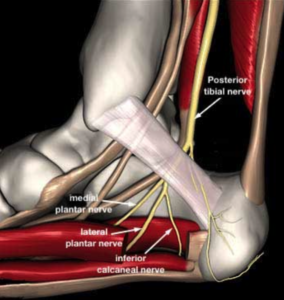
  • Also known as the first branch of the lateral plantar nerve or Inferior Calcaneal nerve. The lateral plantar nerve is a branch of the Tibial nerve, that arises below the tarsal tunnel at the ankle area.
  • It innervates the abductor digiti minimi muscle and the periosteum of the calcaneus and sensory nerves in the region at then calcaneal tuberosity.
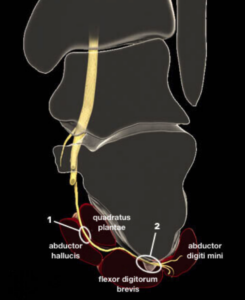
  • Often entrapped at 2 possible sites- *1. Between the deep fascia of the Abductor Hallucis muscle and Quadrates Plantar muscle in the arch of the foot OR 2. more distally just below the heel bone calcaneus at the plantar fascia attachment.
  • Entrapment occurs when the nerve is compressed, leading to heel pain, often confused with plantar fasciitis. Can occur separate to in conjunction of the plantar fasciitis.

Symptoms:

  • Sharp, burning pain, shooting pain on the inside of the heel.
  • Pain often worsens with activity and can be particularly severe in the morning.

Common Causes:

  • Overuse injuries from activities such as running or standing for long periods.
  • Anatomical variations like a heel spur.
  • Inflammation or injury to surrounding tissues. Maybe confused with plantar fasciitis,.
Nerve Entrapments
Nerve Entrapments

Regenerative Treatments for Baxter’s Nerve Entrapment

Regenerative treatments focus on healing the underlying nerve compression and inflammation, promoting long-term relief. Here are the key regenerative options:

5% Dextrose Perineural Injection

Evidence-Based Approach:

  • Procedure: A 5% dextrose solution 0.5 ml is injected under the skin at various spots following the nerve track, just proximal to the symptomatic area. these location are known area of entrapment known as Valley points. Also known as Lyftogt Perineural Injection Therapy.
  • Mechanism: The injection helps to reduce inflammation and mechanical irritation of the nerve. Physical release of the entrapment, and the dextrose normalises nerve function.
  • Benefits: Provides instant pain relief, improves nerve function, and promotes healing. Allows the normal glide of the nerve.
  • Studies:
    • Research has shown that perineural injection therapy (PIT) with 5% dextrose is effective in treating chronic pain related to nerve entrapments, including Baxter’s nerve.

5% Dextrose, PRP and or Vitamin B12 Hydrodissection

Evidence-Based Approach:

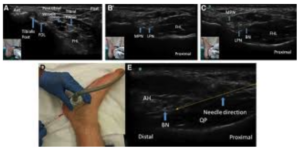
  • Procedure: A 5% dextrose solution/Vitamin B12 or PRP is used to hydro-dissect (separate) the nerve from surrounding tissues/ fascia under Ultrasound Guidance.
  • Mechanism: This technique reduces mechanical compression and inflammation around the nerve. Usually faster than Perineural Injection therapy.
  • Benefits: Provides immediate pain relief and long-term improvement by freeing the nerve from entrapment and normalizing its function.
  • Studies:
    • Clinical evidence supports the efficacy of hydrodissection in reducing pain and improving nerve mobility in peripheral nerve entrapments.

Photobiomodulation (PBM)

Evidence-Based Approach:

  • Procedure: A specialized device emits low-level laser light – red and infra red wavelengths to the affected area.
  • Mechanism: The light energy is absorbed by cells, enhancing cellular function, reducing inflammation, and promoting tissue repair.
  • Benefits: Non-invasive, painless, reduces pain and inflammation, and promotes nerve healing.
  • Studies:
    • PBM has been demonstrated to be effective in reducing neuropathic pain and inflammation, improving nerve function in various clinical settings.
Nerve Entrapments

Combining Regenerative Treatments with Traditional Podiatry Care

Integrating regenerative treatments with traditional podiatric care ensures comprehensive management of Baxter’s nerve entrapment.

Initial Phase

  • Assessment: Confirm diagnosis with a detailed clinical examination and imaging studies if required (ultrasound or MRI). These modalities will not always show the entrapment. Clinical presentation plays a large role in diagnosis.
  • Initial Treatment: Nerve stretches and glides to help free the nerve, shoe advice.
  • Regenerative Treatment:
    • Begin with 5% dextrose perineural injections or hydrodissection with 5% glucose and or Vitamin B12/PRP.
    • Implement photobiomodulation (PBM) sessions to reduce inflammation and promote healing.

Mid Phase

  • Physical Therapy: Introduce a tailored physical therapy program focusing on stretching and strengthening exercises for the foot and ankle.
  • Most of these cases is best to avoid orthotics. Shoes should be cushioning.
  • Continued Regenerative Treatment:
    • Maintain regular perineural  or hydrodissection as needed.
    • Continue PBM treatments to sustain anti-inflammatory effects and support nerve healing.

Long-Term Phase

  • Activity Modification: Wearing appropriate footwear.
  • Maintenance Therapy: Periodic regenerative treatments (e.g., injections or additional PBM sessions) if any symptoms return. In many cases 1-3 sessions of hydrodissection, or 3-6 sessions of perineural injections will resolve the condition
  • Follow-Up Care: Regular follow-up appointments to monitor progress and adjust treatment plans as necessary

Conclusion

Baxter’s nerve entrapment can be effectively managed using a combination of regenerative treatments. Prp/ vitamin B12 and or 5% dextrose perineural injections OR  hydrodissection offer promising results in resolving  pain and promoting nerve healing, while photobiomodulation provides a non-invasive method to enhance recovery. Integrating these treatments with physical therapy, and  appropriate foot wear ensures comprehensive care and long-term relief for patients suffering from nerve entrapments  Our Cheltenham Podiatrists are experts in this field and have trained overseas with world experts. If you are suffering with sharp heel pain, please book online or call the practice for an assessment.

References

    1. Chundru U, Liebeskind A, Seidelmann F, Fogel J, Franklin P, Beltran J. Plantar fasciitis and calcaneal spur formation are associated with abductor digiti minimi atrophy on MRI of the foot. Skeletal Radiol. 2008;37(6):505-510.
    2. Hamblin, M. R. “Mechanisms and Applications of the Anti-Inflammatory Effects of Photobiomodulation.” AIMS Biophysics, 2017.
    3. Rahimzadeh, P., Imani, F., Faiz, S. H. R., et al. “Perineural Injection Therapy with 5% Dextrose for the Treatment of Chronic Sciatica: A Randomized Clinical Trial.” Anesthesiology and Pain Medicine, 2017.
    4. Wu, Y. T., Ho, T. Y., Chou, Y. C., et al. “Hydrodissection for Carpal Tunnel Syndrome: A Randomized, Controlled, Double-Blind Clinical Trial.” Muscle & Nerve, 2019.
    5. Wu Y-T, Chen Y-P, Lam KHS, Reeves KD, Lin J-A, Kuo C-Y. Mechanism of Glucose Water as a Neural Injection: A Perspective on Neuroinflammation. Life. 2022; 12(6):832. https://doi.org/10.3390/life12060832

Book an appointment

GET EXPERT TREATMENT FOR NERVE ENTRAPMENTS

Here at Cheltenham Podiatry, our foot and ankle experts have over 10 years of training in treating such nerve conditions.

If you or you know someone whom is suffering with nerve entrapments, please call and make a time to see if you are a good candidate for the treatment.

Make an appointment by filling in our form below, or alternatively, you can give us a call on 03 9583 3093.

Nerve Entrapments