Plantar Fasciitis can be rectified with treatment from a qualified podiatrist.
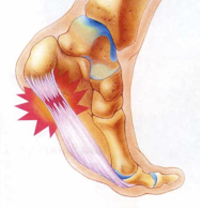
It is an inflammation, irritation or degeneration of the plantar fascia. The plantar fascia is a band of tissue under the foot that connects the heel bone to the ball of the foot. Thus the condition can form anywhere along its length, usually it will be affected at the arch or heel. It can cause debilitating heel pain, that can impinge on daily life and affect mobility. On cadaver dissections, the fibres from the fascia connect to the achilles tendon. So there is a close relationship between the two structures. For this reason rehabilitation will require achilles and calf exercises.
In the past, this condition was known as heel spur syndrome. However, current research suggests that plantar fasciitis and heel spur are related, but the pain is rarely generated from the spur. The spur is associated with the chronic pulling and inflammation of the fascia from its attachment to the heel bone.
Initially it will present on scans as a thickening of the plantar fascia, however if left untreated it can progress, and lead to more severe changes, as tears, bone oedema and bursitis. These become more difficult to treat with standard care, and usually fail conservative care.
Other causes of heel pain include Baxters nerve irritation, medial calcaneal nerve irritation, or fat pad fracture. Quite often plantar fascia pathology can also lead to Baxters nerve irritation, and also bursitis. So often, most plantar fascia conditions will have several structures affected- the fascia itself maybe thickened, due to the swelling of the fascia, baxters nerve becomes irritated, and in some cases bursitis will form due to the damage to the plantar fascia.
For this reason, a thorough clinical assessment often combined with radiology- ultrasound assessment and in some cases MRI maybe warranted. Accurate diagnosis is crucial to provide an appropriate treatment plan. Our foot and ankle experts utilise onsite high end ultrasound to expedite our diagnostic capability.
Thus once the detailed diagnosis has been made, an individualised treatment program is developed that takes into account the tissues affected, patient factors, and severity of fascia damage.

A common symptom is pain in the heel or arch area. Particularly when standing up first thing in the morning and after rest. In addition, the pain may then go away, but usually returns throughout the day. Usually pain is described as an ache, if Baxters nerve is also affected there will her sharp, shooting and or burning pain as well. The condition can be painful and debilitating. Over time a tear in the plantar fascia can forms, and in some cases bone oedema. Bone oedema and tears are often missed and left untreated causing significant pain. Such complex cases require a specific tailored treatment program.
Bone oedema can only be picked up on MRI scans. It is a swelling inside the bone close to the plantar fascia attatchment and causes a deep pain. This is where our regenerative solutions play an important role. Our latest technology EMTT has strong evidence for resolving bone conditions as bone oedema. In such cases the treatment program will require some sessions of the EMTT .
It is typically caused by a combination of poor biomechanical foot function, poor footwear choices, standing long hours on hard surfaces, and/or acute injury.
For a heel pain due to standard plantar fascia condition treatment often involves radial shockwave, taping, rehabilitation, padding, orthotic devices and modifications to footwear when there is indications of biomechanics involvement. These treatments redistribute forces away from the problem area in order to reduce inflammation and pain, encourage healing and prevent recurrence.
For more severe and complex cases where severe (fascia tears) or other tissue damage has occurred (baxters nerve, bone oedema, bursitis), solutions require advanced treatments in regenerative medicine. These therapies include photobiomodulation (low level laser/cold laser), EMTT, prolotherapy, platelet rich plasma, and protein concentrates(from prp). Our foot and leg experts often see severe and complex cases, that have not been diagnosed correctly and thus incorrectly treated.
Correct diagnosis is crucial. Each case is individual, our foot and leg experts tailor the treatment to your individual situation.
For successful outcomes , all the affected tissues need to be treated appropriately.
With the help of your podiatrist, plantar fasciitis can be treated effectively and prevented in the future.
Book an appointment using our form below, or call our team today on 03 9583 3093.
© Copyright 2026, Cheltenham Podiatry | SBM
FESTIVE CLOSURE DATES: We will be closed from December 23rd 2025 and will reopen on January 5th. Happy holidays!